🇦🇹Austria, Graz
ACL advanced commerce labs GmbH
ACL advanced commerce labs GmbH specializes in customer-centric solution design, software development, and business process outsourcing for commerce and digitalization projects, supporting international retailers and brands since 1999.
🇦🇹Austria, Linz
ACRIS E-Commerce GmbH
ACRIS E-Commerce GmbH specializes in E-Commerce consulting and the development of Shopware webshops, offering a range of services including custom templates and plugins. They are a certified Shopware Gold Partner with extensive experience in B2B and B2C projects.
🇦🇹Austria, Linz
chiliSCHARF GmbH
chiliSCHARF GmbH is a digital agency specializing in website creation, online marketing, and email marketing, with expertise in various platforms including Shopware and Magento.
🇦🇹Austria, Innsbruck
connexion trawöger, schwarz og
connexion e.solutions is a digital agency based in Innsbruck, Austria, specializing in eBusiness solutions, including web design, online shops, and custom software development. As a long-standing Shopware Business Partner, they offer expertise in creating effective e-commerce solutions.
🇦🇹Austria, Grödig
gesagt.getan. GmbH
gesagt.getan. GmbH is an online marketing agency based in Salzburg that specializes in creating customized websites and digital marketing strategies to enhance online presence.
🇦🇹Austria, Wien
IWAVES Medientechnik e.U.
IWAVESMEDIA is a full-service digital agency specializing in web and software development, e-commerce applications, and custom solutions, with expertise in platforms like Shopware, Shopify, and Magento.
🇦🇹Austria, Villach
LOGMEDIA GmbH
LOGMEDIA GmbH specializes in digital consulting, project management, and e-commerce solutions, offering services for various platforms including Shopware, Shopify, and WooCommerce.
🇦🇹Austria, Wien
Moonshiner GmbH
Moonshiner GmbH specializes in building and enhancing digital products, focusing on e-commerce solutions, user experience design, and custom software development. They have successfully completed over 100 projects since their establishment in 2015.
🇦🇹Austria, Graz
Mountain Media
Mountain Media is your partner for developing tailored digital solutions and comprehensive eCommerce concepts, specializing in Shopware and various other services.
🇦🇹Austria, Graz
Onlineschmiede Maximilian Wunderl
Onlineschmiede is a full-service web agency based in Graz, specializing in web development, e-commerce solutions, and digital marketing services using various technologies including Shopware, Shopify, and WooCommerce.
🇦🇹Austria, Linz
Studio Mitte
Studio Mitte is a digital solutions agency specializing in web design, development, and strategy, working collaboratively with clients to create tailored solutions. They are certified Shopware developers but also engage in various other digital projects.
Why Choosing the Right Shopware Agency Matters
An online store is far more than a technical platform. It is a storefront, a sales channel, and often the very first touchpoint between a brand and its customers. By choosing Shopware, you have opted for one of the most powerful e-commerce systems in Europe. But even the best technology only reaches its full potential with the right implementation partner.
The market for Shopware agencies is large and, at first glance, difficult to navigate. Small specialist teams sit alongside established full-service agencies, regional providers alongside internationally positioned companies. The differences lie not just in price, but above all in specialisation, industry experience, and technical depth. An agency that builds outstanding B2C shops is not automatically the right choice for a complex B2B portal with custom pricing logic and ERP integration.
That is why a structured comparison pays off. When you evaluate several agencies side by side, you quickly see which partner truly understands your requirements and where the greatest overlap in expertise lies. Especially for complex projects like migrating to Shopware 6, building an international storefront, or integrating third-party systems, the choice of agency can determine the success of the entire project.
Shopware Agencies Around the World: Where Are the Experts?
Shopware was founded in Schöppingen, Germany, and the ecosystem still reflects those roots. The DACH region (Germany, Austria, Switzerland) is the heartland of the Shopware world. Cities like Berlin, Hamburg, Munich, Cologne, Dusseldorf, and Stuttgart are home to an exceptionally high concentration of certified agencies. Many of them have worked closely with Shopware for years and bring deep platform knowledge to every project. Austria, particularly Vienna and Graz, as well as Switzerland, also host specialised providers serving the German-speaking market.
But Shopware is no longer a purely German phenomenon. The Netherlands has developed a vibrant agency scene that benefits from its geographic and cultural proximity to the German market. Poland has become an important location with a growing number of technically strong agencies, often offering an attractive balance of quality and cost. In the United Kingdom, Scandinavia, and Southern Europe, Shopware partners are also becoming increasingly established.
Beyond Europe, the network is expanding in North America, Southeast Asia, and India. For internationally positioned businesses, this opens up interesting possibilities: teams across different time zones, local market knowledge, and often cost advantages. Companies selling across borders frequently benefit from an agency that has experience with multilingual shops and country-specific requirements.
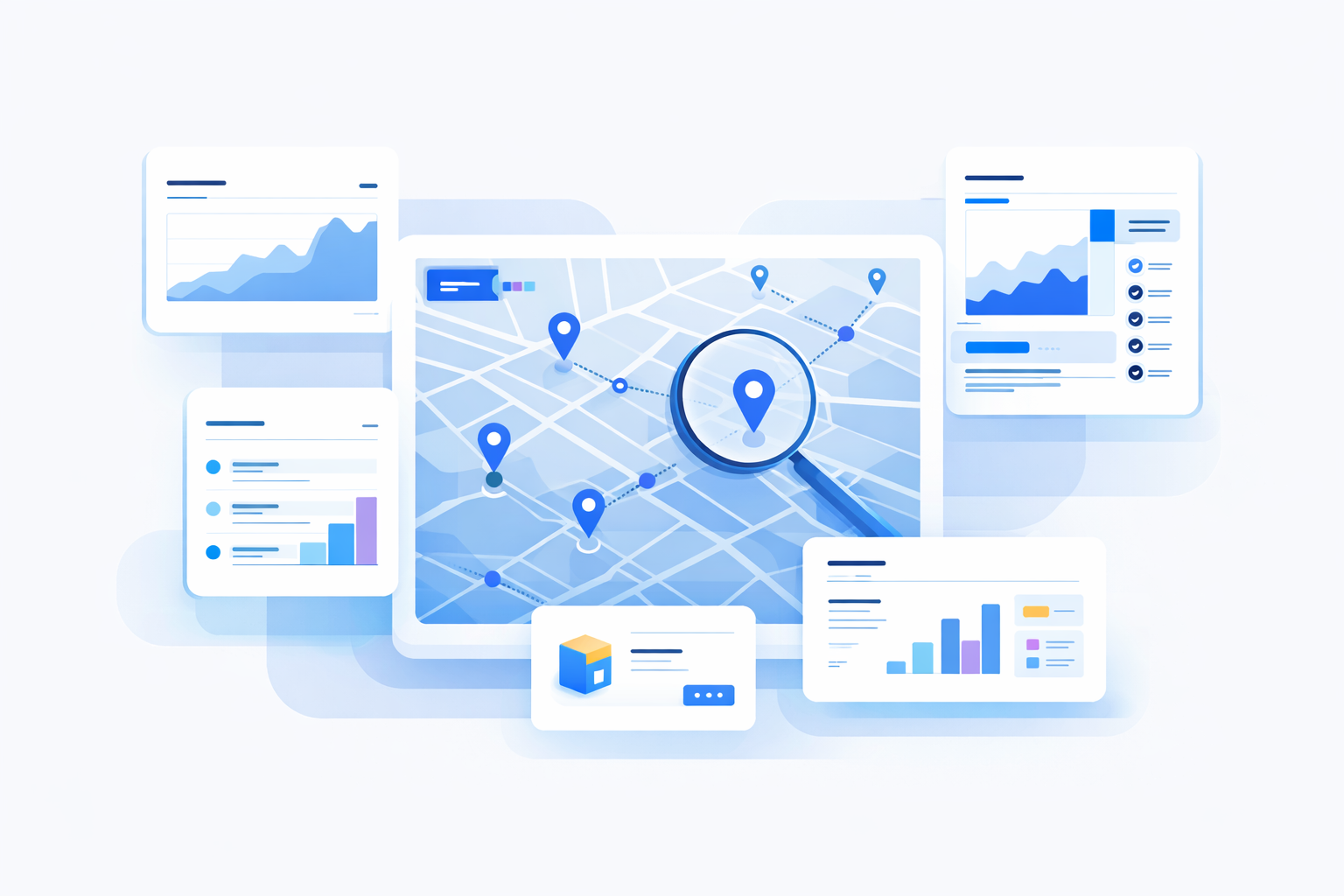
Our interactive map gives you a complete overview of the global agency landscape. Filter by continent, country, or region and see at a glance where specific expertise is based.
Shopware 6: A Modern Architecture as the Foundation
With Shopware 6, the company made a fundamental new start. The platform is built on the Symfony framework, an architecture widely regarded as the gold standard in the PHP world. For agencies and developers, this means that anyone proficient in Symfony can get up to speed with Shopware 6 quickly. The clean separation of business logic, data layer, and presentation makes it possible to implement even complex requirements without accumulating technical debt.
The result is a system that lends itself exceptionally well to custom development. Whether it is bespoke plugins, custom API endpoints, or deep process automation, Shopware 6 gives agencies the tools to address virtually any requirement. At the same time, the active open-source community ensures the ecosystem stays vibrant and continues to grow.
Cloud or Self-Hosted: Which Hosting Model Fits Your Project?
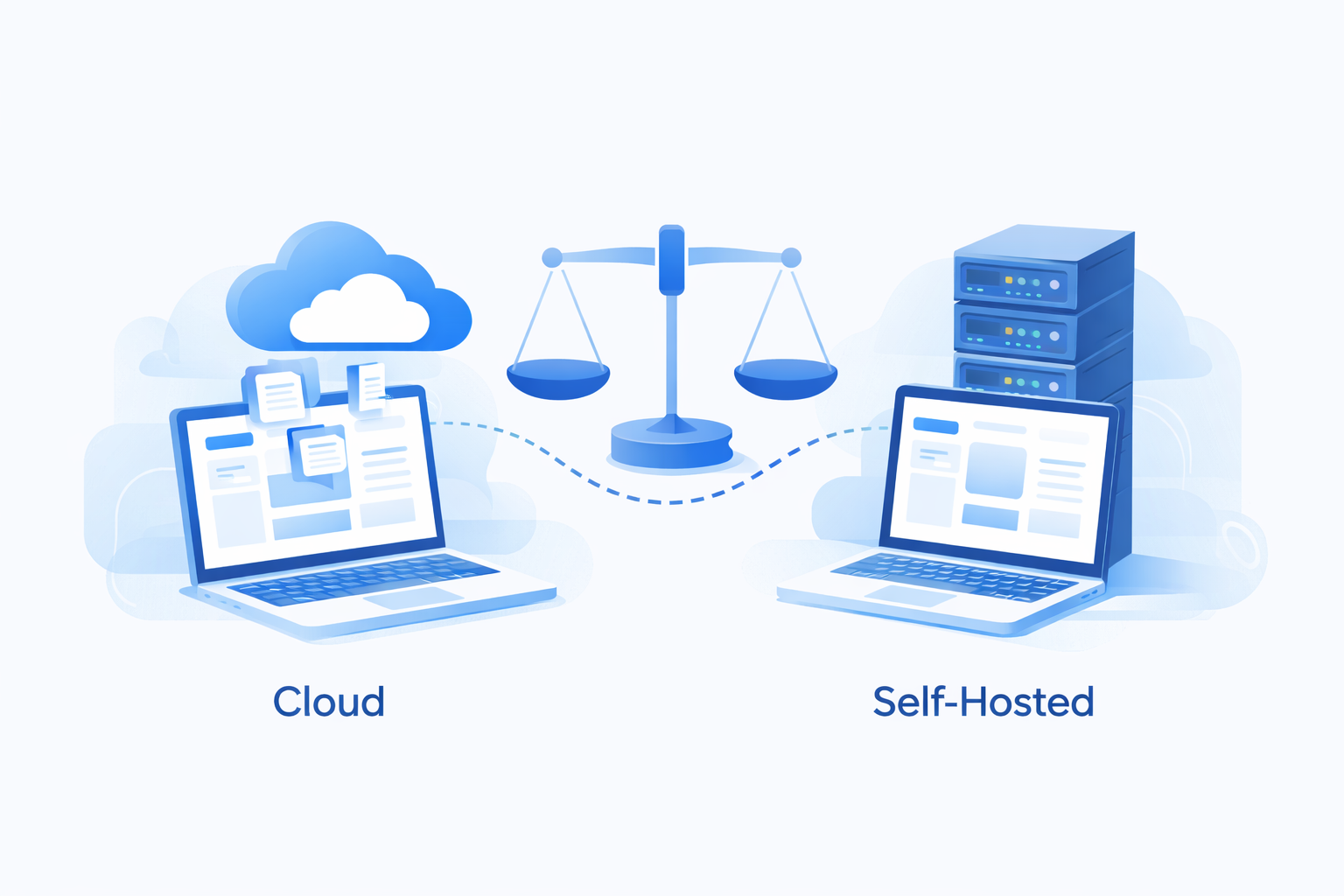
One of the first strategic decisions concerns hosting. Shopware offers two fundamentally different approaches, and the choice has far-reaching consequences for operations, cost, and flexibility.
Shopware Cloud is the managed option. Shopware itself takes care of servers, updates, security patches, and scaling. For merchants who want to launch quickly without investing in their own DevOps, this is an attractive model. The shop runs reliably without the need to manage infrastructure. For smaller and mid-sized projects, or for teams without dedicated server expertise, Shopware Cloud is often the most pragmatic starting point.
Shopware Self-Hosted gives you full control. You run the shop on your own or rented infrastructure and can determine every aspect of the server environment yourself. This means more effort, but also more freedom: custom server configurations, your own deployment pipelines, full control over performance tuning. For high-traffic shops, projects with specific compliance requirements, or highly customised technical setups, self-hosted is often the better choice.
For performance-critical shops, infrastructure optimisation plays a central role. Technologies like Redis are frequently deployed as a caching layer to reduce database queries and noticeably improve page load times. Combined with a well-configured web server, stable response times can be achieved even under heavy load. An agency with experience in server optimisation can make a decisive difference here.
Headless Commerce with Shopware Frontends
The trend towards headless commerce has reached the Shopware ecosystem, and with Shopware Frontends, the platform offers its own approach to it. The principle is straightforward: the presentation layer is completely decoupled from the backend. The Shopware backend delivers data through a powerful API, while the frontend is built independently using modern JavaScript frameworks such as Vue.js or React.
What does this mean in practice? Maximum creative freedom, lightning-fast load times, and the ability to run different frontends for different channels: a classic web shop, a Progressive Web App, and a specialised B2B interface, all fed from the same backend.
However, headless is not an end in itself. The approach brings added complexity in development and operations and makes the most sense when the standard storefront reaches its limits. Agencies experienced with Shopware Frontends can realistically assess whether the headless approach is worthwhile for your project, or whether a classic implementation will get you to your goal more efficiently.
Payment Providers, Integrations, and the Bigger Picture
An online store does not exist in a vacuum. It is part of a larger system encompassing payment processing, inventory management, logistics, marketing, and customer service. The quality of these integrations largely determines the efficiency of day-to-day operations.
When it comes to payments, Klarna is one of the most widely used solutions in the Shopware ecosystem. Invoice payments, instalments, instant bank transfer: flexible payment options are proven to increase conversion rates and reduce checkout abandonment. But other providers like PayPal, Stripe, Mollie, and Adyen also play important roles depending on the target market. An experienced agency knows the strengths and characteristics of different payment providers and can configure the checkout to suit your audience.
Equally important are the connections to backend systems. Synchronisation with ERP solutions such as SAP, Microsoft Dynamics, or smaller inventory management systems ensures that stock levels, prices, and orders are automatically reconciled. PIM systems like Akeneo help manage product data centrally and deliver it consistently to the shop. Marketing automation tools, CRM systems, and analytics platforms complete the picture.
Shopware provides extensive integration options through its REST API and plugin marketplace. What matters is that the agency can not only implement individual interfaces but also keep the interplay of all systems in view. After all, a perfectly functioning Klarna integration is of little use if order data does not flow cleanly into the ERP.
What to Look for When Choosing a Shopware Agency
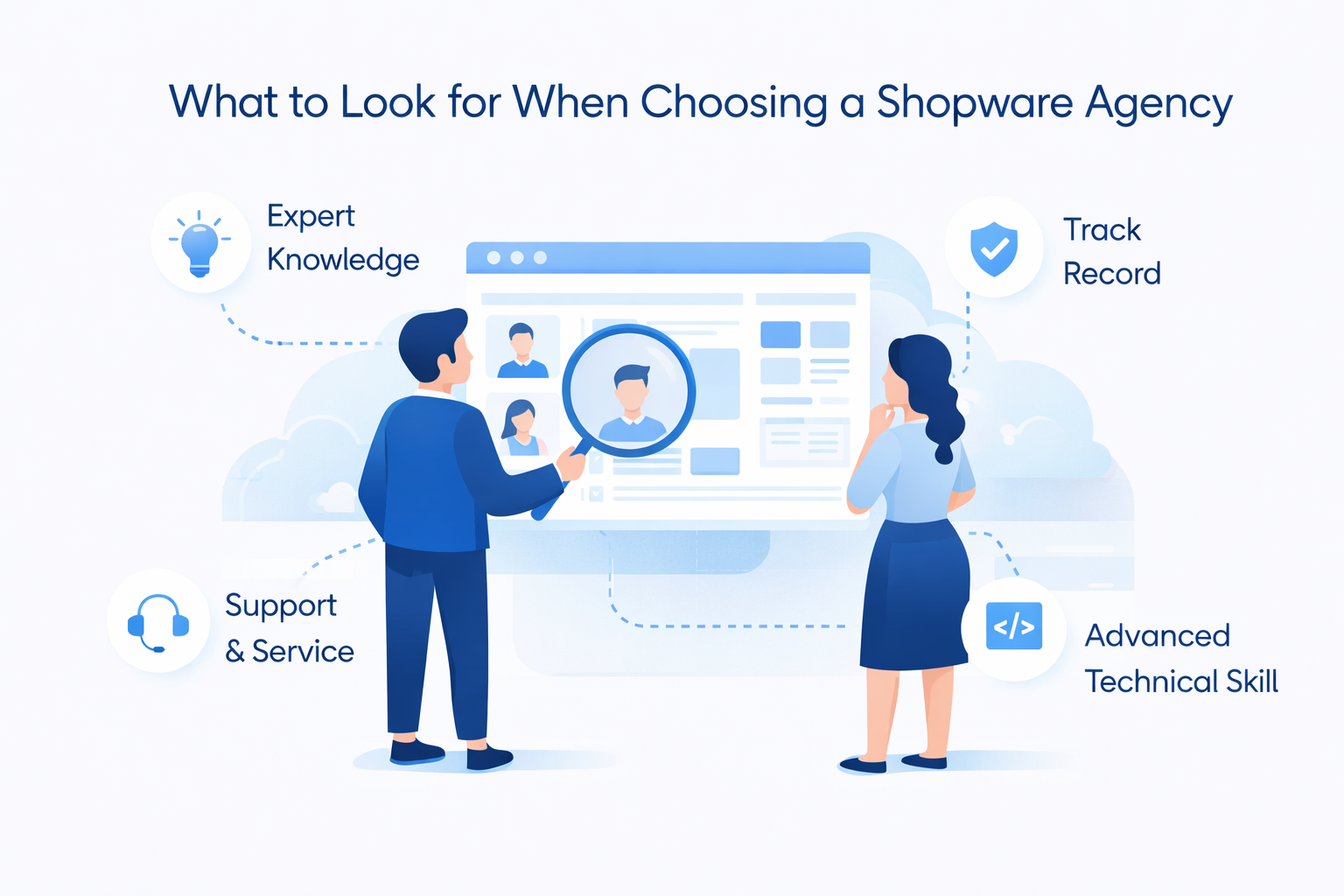
The search for the right agency becomes much simpler when you know which criteria truly matter.
Certification and Partner Level
Shopware awards official partner tiers: Bronze, Silver, Gold, and Platinum. This classification is based on factors such as the number of completed projects, employee certifications, and engagement within the Shopware ecosystem. A higher partner level is an indicator of experience, but not automatically a guarantee of the best solution for your specific case. A Silver agency with deep industry knowledge can be a better choice than a Platinum partner with no experience in your niche.
Technical Specialisation
Not every agency covers the entire Shopware spectrum, and that is perfectly fine. Some focus on Shopware Cloud, offering fast, standardised implementations. Others are specialists in complex self-hosted installations with custom server setups. Still others have their strength in headless projects using Shopware Frontends. Ask specifically about experience with the hosting model and technical approach you are pursuing.
Industry Experience
A fashion e-commerce store has different requirements than a B2B spare parts shop or a marketplace for digital products. Agencies that have already completed projects in your industry know the typical challenges, proven solutions, and sector-specific nuances. This saves time, reduces risk, and generally leads to better results.
Location and Collaboration
In practice, working with an agency functions well both on-site and remotely, provided the communication is right. For businesses that value face-to-face workshops and regular in-person meetings, a regional partner can offer advantages. For those who collaborate digitally anyway, the world is open, and agencies anywhere on the globe can be considered.
References and Track Record
Ask to see specific reference projects, ideally ones comparable in scope and industry. Pay attention to how the agency talks about challenges and their solutions. A partner who speaks openly about difficulties in past projects is often more trustworthy than one who only presents polished success stories.
Compare Shopware Agencies and Find the Right Partner
The search for the right Shopware agency starts with a solid overview. Our interactive map shows you at a glance which agencies operate in which countries and regions. Filter by continent, country, and area of expertise, whether Shopware Self-Hosted, Shopware Cloud, or Shopware Frontends.
Each agency profile gives you a quick orientation on location, partner level, and technical focus. This way, you can build a qualified shortlist in just a few minutes and reach out directly to the agencies that truly fit your project.